Reviews · 2026-05-26
Cursor vs Codex: which AI coding workflow breaks fewer pull requests?
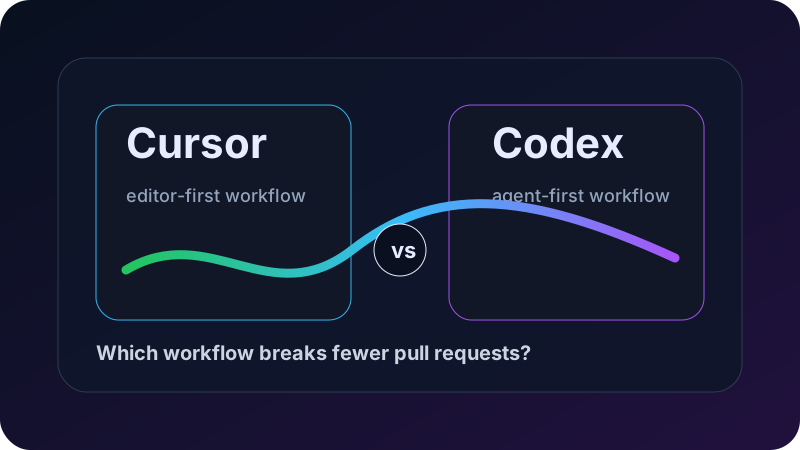
Cursor and Codex are not the same kind of tool. Cursor starts from the editor and keeps the developer close to the code. Codex starts from the task and can run as a terminal or cloud-style coding agent. That difference matters more than model scores.
Public sources checked: Cursor homepage/docs; OpenAI Codex developer page; public openai/codex repository. No private benchmark or hands-on performance claim is made here.
Short verdict
Choose Cursor if your team wants AI help inside the daily editing loop: reading files, changing code in place, using rules, and keeping a human developer in the seat. Choose Codex if your team wants to hand off bounded tasks, inspect command logs, and review a finished patch like work from a junior engineer.
The wrong way to buy either tool is to ask which one is “smarter”. Smart is cheap. Reviewable is what saves you. A coding agent that edits ten files without a clean reason can burn more time than it saves.
The comparison that actually matters
For engineering teams, the question is not “can it write code?” Both can. The useful question is: after the tool touches the repository, can a reviewer understand the change quickly enough to trust it?
A good AI coding workflow leaves a trail: files inspected, commands run, tests passed or failed, assumptions made, and a diff that can be reverted without drama. If the tool gives you a giant patch and a cheerful summary, you do not have productivity. You have a mystery box.
Where Cursor feels better
Cursor is strongest when the developer is already inside the repository and wants the assistant to work as part of the editor. The product is positioned around an AI coding environment, with agent features, rules, MCP support, CLI options and team controls documented by Cursor. The practical advantage is proximity: you see the file, the suggestion, and the surrounding code before the change becomes a commit.
That makes Cursor a good fit for product engineers, frontend work, small refactors, test scaffolding, and “explain this part of the codebase” sessions. The human stays close enough to catch weird assumptions. That closeness is boring, but boring is good when production code is involved.
Where Codex feels better
OpenAI describes Codex as one agent for the places you code, and the public Codex repository calls it a lightweight coding agent that runs in the terminal. The developer docs also point to workflows such as sandboxing, auto-review, subagents and local environments. In plain English: Codex is built for task execution, not just inline completion.
That can be better for issues with a clear boundary: “fix this failing test”, “add this missing validation”, “update this endpoint and run the suite”. Codex is easier to judge when it behaves like a worker producing a patch plus command history. You still need review, but the unit of work is clearer.
Decision table for teams
Use Cursor when the work is exploratory, when the developer needs to steer every few minutes, or when the value comes from understanding the code while editing it. Use Codex when the work can be described as a ticket, when shell output matters, and when you want the agent to come back with a reviewable result.
If your repository has weak tests, Cursor is usually safer because a human remains in the loop. If your repository has strong tests and small tasks, Codex can be more useful because the agent can run, fail, adjust and report. If your team has neither tests nor review discipline, do not start with agents. Start with tests.
Security and data access checklist
Before a pilot, decide what the assistant may read, what it may execute, and what it may never touch. For coding tools this is not paperwork. A repo can contain API keys in old commits, private customer logic, deployment scripts, billing code and internal URLs.
A sane pilot blocks production credentials, uses a non-critical repo or branch, disables broad write access, and requires human approval before pushing anything. Also check vendor terms, data use language, admin controls, retention settings, and whether enterprise features are needed for your risk level. Do not learn those details after the first incident.
A trial plan that exposes the truth
Run both tools on the same five tasks: one bug fix, one small feature, one test-only task, one refactor, and one documentation cleanup. Measure diff size, number of files touched, test output, time to review, and how often the reviewer has to ask “why did it do that?”
Do not score the prettiest demo. Score the boring aftertaste. Did the code get simpler? Did the test log make sense? Could a new engineer read the patch? Did the tool admit uncertainty, or did it act confident while guessing?
Who should avoid each tool
Avoid Cursor as the main workflow if your team wants asynchronous agents to pick up tickets while engineers do something else. Cursor can do more than autocomplete, but its natural home is still the developer workspace.
Avoid Codex if your tasks are vague, your repo cannot run locally, or nobody has time to review generated patches. Agentic coding without review is not automation. It is unattended editing.
Bottom line
Cursor is the safer default for teams that want AI beside the developer. Codex is the more interesting choice for teams that want AI to take bounded tasks and return patches. The best setup may use both: Cursor for thinking through code, Codex for contained execution.
But if you remember one thing, make it this: buy the workflow that makes review easier. Faster typing is nice. Fewer broken pull requests are worth more.
Methodology: public-evidence review
We did not access a live dashboard, make a payment, run a full product test or verify private customer data for this page. This review summarizes public evidence, product pages, documentation and visible claims available on the verification date.
What we could not verify
We could not verify private customer outcomes, internal security controls, non-public pricing, private contracts or dashboard-only features unless the page explicitly says otherwise.
Sources and verification date
Verification date: 2026-06-14. These links support the verification framework for this public-evidence page; private dashboard-only claims remain unverified unless stated in the article.