Best PDF note-taking and annotation apps for students in 2026
A student-focused comparison of PDF annotation apps for lecture slides, research papers, handwritten notes, offline reading and clean export before you change devices.
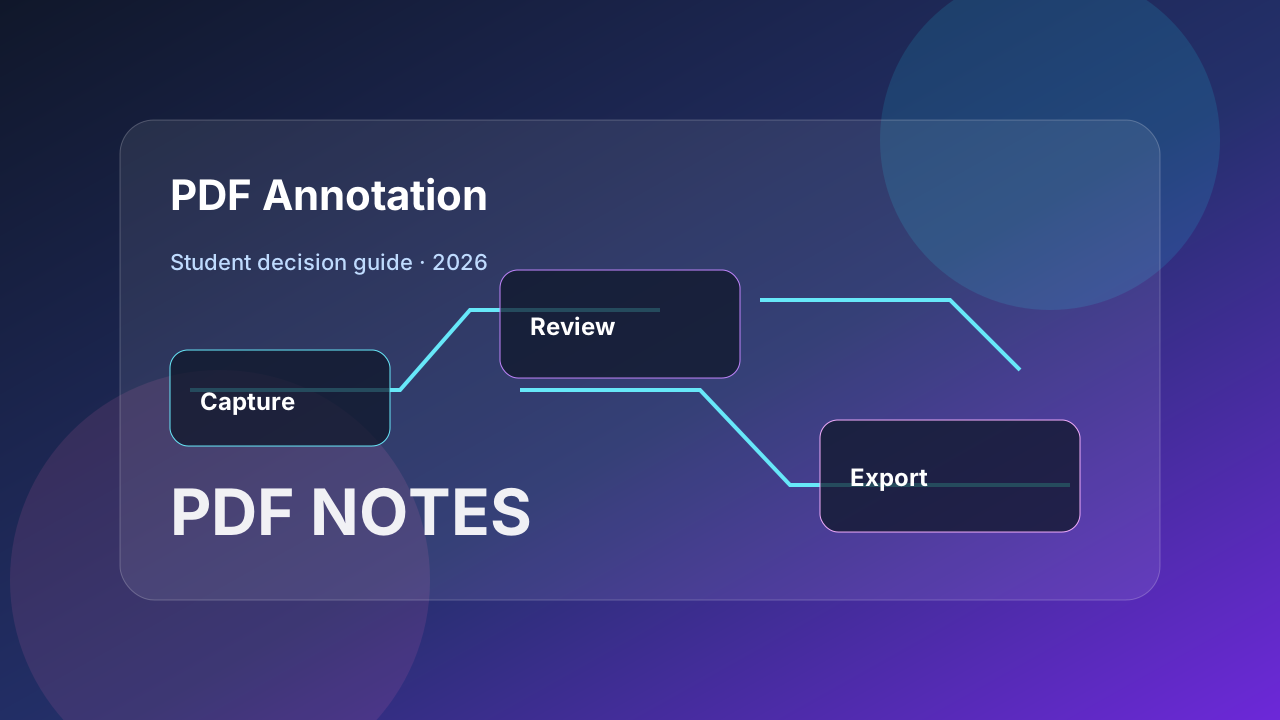
The best app is the one that survives week seven, when lectures pile up and the exam calendar stops being theoretical. A beautiful tool that takes twenty minutes to maintain will lose to a plain tool that lets you review on the bus. This guide treats student study as a workflow, not as a feature checklist.
We looked at public product pages and pricing documentation in June 2026, then compared each tool by capture speed, review discipline, export options, offline reliability and how easy it is to leave later. Exact prices and student discounts change, so the links go to official pages rather than frozen numbers.
Short version
- Goodnotes / Notability: handwriting, lecture slides and iPad-heavy study routines.
- OneNote / Xodo: mixed typed notes, PDFs, notebooks and Microsoft school accounts.
- LiquidText and specialist tools work best when the course format matches their strengths.
- Do not trust generated material blindly: review source notes, export a sample, and test offline access before exams.
How to choose
Start with the bottleneck in your course. If you lose points because facts do not stick, spaced repetition matters more than a pretty notebook. If your problem is dense reading, annotations and export matter more than AI generation. If your group shares material, collaboration and web access move up the list.
AI can turn notes into first drafts of questions, but it cannot know what your professor will emphasize unless the source notes are clean. Treat generated cards or summaries as a rough assistant: delete vague prompts, split overloaded cards, and keep the answer short enough to recall without rereading a paragraph.
Do not move your whole study system during finals week. Trial one lecture, one reading and one revision session first. If the tool makes those three moments easier, then migrate the rest.
Comparison table
| App | Best fit | Watch out |
|---|---|---|
| Goodnotes | handwriting, lecture slides and iPad-heavy study routines | less compelling if you mostly type on Windows or web |
| Notability | recorded lectures plus handwritten annotation workflows | subscription terms and export habits need checking |
| OneNote | mixed typed notes, PDFs, notebooks and Microsoft school accounts | PDF handling can feel less precise than dedicated annotators |
| Xodo | cross-platform PDF markup, signing and practical document work | advanced features may sit behind paid plans |
| LiquidText | research reading, excerpts and connecting ideas across documents | overkill for simple highlighting |
| Adobe Acrobat | standard PDF compatibility and formal document exchange | can be heavier and more expensive than students need |
| Apple Preview / Files | free basic annotation on Mac, iPad and iPhone | not a full study database |
| Drawboard PDF | pen-first PDF markup, especially on Windows tablets | best fit depends heavily on device and plan |
- Need memory under exam pressure? start with spaced repetition.
- Need to process source material? choose the app that captures your notes with least cleanup.
- Need handwriting or PDFs? prioritize pen latency, page navigation and export.
- Need group study? check sharing, web access and account limits before building the deck.
Apps compared
Goodnotes
Goodnotes is strongest when handwriting, lecture slides and iPad-heavy study routines. For students, the real question is not whether the product has a long feature list, but whether it reduces the friction between class, review and the next assignment. Use it when: choose it for a single course first, export a sample set, and check the official page before assuming a free or paid limit. Avoid it when: less compelling if you mostly type on Windows or web.
A sensible test is one lecture, one messy source file and one review session two days later. If the app still feels clear after that, it has earned a place in your routine; if not, do not rescue it with more folders and rules.
Notability
Notability is strongest when recorded lectures plus handwritten annotation workflows. For students, the real question is not whether the product has a long feature list, but whether it reduces the friction between class, review and the next assignment. Use it when: choose it for a single course first, export a sample set, and check the official page before assuming a free or paid limit. Avoid it when: subscription terms and export habits need checking.
A sensible test is one lecture, one messy source file and one review session two days later. If the app still feels clear after that, it has earned a place in your routine; if not, do not rescue it with more folders and rules.
OneNote
OneNote is strongest when mixed typed notes, PDFs, notebooks and Microsoft school accounts. For students, the real question is not whether the product has a long feature list, but whether it reduces the friction between class, review and the next assignment. Use it when: choose it for a single course first, export a sample set, and check the official page before assuming a free or paid limit. Avoid it when: PDF handling can feel less precise than dedicated annotators.
A sensible test is one lecture, one messy source file and one review session two days later. If the app still feels clear after that, it has earned a place in your routine; if not, do not rescue it with more folders and rules.
Xodo
Xodo is strongest when cross-platform PDF markup, signing and practical document work. For students, the real question is not whether the product has a long feature list, but whether it reduces the friction between class, review and the next assignment. Use it when: choose it for a single course first, export a sample set, and check the official page before assuming a free or paid limit. Avoid it when: advanced features may sit behind paid plans.
A sensible test is one lecture, one messy source file and one review session two days later. If the app still feels clear after that, it has earned a place in your routine; if not, do not rescue it with more folders and rules.
LiquidText
LiquidText is strongest when research reading, excerpts and connecting ideas across documents. For students, the real question is not whether the product has a long feature list, but whether it reduces the friction between class, review and the next assignment. Use it when: choose it for a single course first, export a sample set, and check the official page before assuming a free or paid limit. Avoid it when: overkill for simple highlighting.
A sensible test is one lecture, one messy source file and one review session two days later. If the app still feels clear after that, it has earned a place in your routine; if not, do not rescue it with more folders and rules.
Adobe Acrobat
Adobe Acrobat is strongest when standard PDF compatibility and formal document exchange. For students, the real question is not whether the product has a long feature list, but whether it reduces the friction between class, review and the next assignment. Use it when: choose it for a single course first, export a sample set, and check the official page before assuming a free or paid limit. Avoid it when: can be heavier and more expensive than students need.
A sensible test is one lecture, one messy source file and one review session two days later. If the app still feels clear after that, it has earned a place in your routine; if not, do not rescue it with more folders and rules.
Apple Preview / Files
Apple Preview / Files is strongest when free basic annotation on Mac, iPad and iPhone. For students, the real question is not whether the product has a long feature list, but whether it reduces the friction between class, review and the next assignment. Use it when: choose it for a single course first, export a sample set, and check the official page before assuming a free or paid limit. Avoid it when: not a full study database.
A sensible test is one lecture, one messy source file and one review session two days later. If the app still feels clear after that, it has earned a place in your routine; if not, do not rescue it with more folders and rules.
Drawboard PDF
Drawboard PDF is strongest when pen-first PDF markup, especially on Windows tablets. For students, the real question is not whether the product has a long feature list, but whether it reduces the friction between class, review and the next assignment. Use it when: choose it for a single course first, export a sample set, and check the official page before assuming a free or paid limit. Avoid it when: best fit depends heavily on device and plan.
A sensible test is one lecture, one messy source file and one review session two days later. If the app still feels clear after that, it has earned a place in your routine; if not, do not rescue it with more folders and rules.
Privacy, export and lock-in
Student notes can contain names, grades, medical cases, client details from internships or unpublished research. Before uploading a semester of material, check whether the app lets you export in a usable format, whether offline use works on your device, and whether school rules restrict cloud tools.
Do not move your whole study system during finals week. Trial one lecture, one reading and one revision session first. If the tool makes those three moments easier, then migrate the rest.
A useful rule is to run a weekly clean-up: archive finished topics, rename vague files, remove duplicated generated material and export one backup. That boring habit is what keeps a study app from turning into another place where information disappears.
One final check is boring but valuable: open the app on the smallest screen you use, search for a topic from three weeks ago, and try to continue without Wi‑Fi. If that moment feels slow, the app will punish you during travel days, library sessions and last-minute revisions. Good study software should disappear into the routine rather than demand a new routine of its own.
Before you choose
- Export policy: Can you download your data in a standard format?
- Offline access: Does it work when Wi‑Fi is down?
- Search speed: Can you find a week-old note in under ten seconds?
- Device fit: Does it sync smoothly across your study devices?
- School rules: Are cloud tools permitted under your institution's policy?
A practical study workflow
Start with the moment when the material enters your week. For a lecture-heavy course, the tool should capture slides, notes or cards before you lose context. If the first import creates a messy pile that you dread opening later, the app is not saving time; it is moving the work into a different room.
The second moment is review. A good student workflow makes it obvious what to do next: today’s cards, this week’s reading, the marked pages for tomorrow’s seminar, or the weak topics before an exam. If every session begins with reorganising folders, the design has failed even if the feature list looks impressive.
The third moment is recovery. Students miss classes, switch devices, lose Wi‑Fi, and sometimes discover a subscription limit when they need a file most. Before trusting any tool, simulate one bad day: open it on your phone, search an old topic, export a sample, and check whether the result is still usable outside the app.
Finally, keep the system small. One app can be excellent for memory, another for annotated reading, and a third for long notes, but three half-maintained systems become a tax. Choose the tool that removes the most repeated friction in your course, not the one that promises to replace every study habit.
What to check before paying
Common mistakes
Migration and export test
Run a five-minute exit drill before you commit: export one deck or marked PDF, open it in a different app, check that links and notes survive, then rename the file as if you were archiving the course. If that feels painful with one sample, it will be worse after twelve weeks of material.
Methodology and sources
Official product pages and support materials were checked in June 2026. We compared public feature claims, platform fit, export risk and student workflow fit; we did not invent fixed prices, ratings, hands-on tests or benchmark results.
FAQ
What is the best app to take notes on a PDF?
For handwritten notes on an iPad, Goodnotes and Notability are the two strongest options; for typed notes and highlights across platforms, OneNote and Xodo are practical free starting points. The comparison above maps each app to a device and study style.
Can I take notes on a PDF for free?
Yes. Apple Preview on Mac, OneNote and Xodo all let you highlight and annotate PDFs at no cost. Free tiers cover basic annotation; paid plans mostly add cross-device sync, unlimited notebooks and OCR search.
What study apps integrate with PDF notes best?
Goodnotes and Notability keep PDF annotations searchable next to your handwritten notebooks, LiquidText links excerpts across research PDFs, and OneNote mixes PDF printouts with typed notes. Whichever you pick, check that annotations export together with the PDF.
Which PDF annotator should schools use for students?
For shared devices, a browser-based tool like Xodo avoids per-device installs; for 1:1 iPad programs, Goodnotes and Notability are the common choice. In both cases, verify export and account portability so student work survives a device change.
How do I take handwritten notes on PDF lecture slides?
Import the slides into a handwriting app such as Goodnotes, Notability or OneNote and write with a stylus, leaving margin space for your ink. All three sync across devices and export an annotated copy of the PDF.
How do I keep my PDF notes when switching apps?
Before committing, export one annotated PDF and open it in a different viewer: highlights and notes should travel with the file, not stay locked inside the app. If export flattens or drops your annotations, treat that as a lock-in warning.